Motorcycle accidents involving rideshare vehicles can present issues that are different from an ordinary collision between two privately operated vehicles. When an Uber or Lyft driver is involved in a crash with a motorcyclist, the circumstances surrounding the driver’s rideshare activity may become important when determining insurance coverage, liability, and available sources of compensation.
Orange County has a large network of busy streets, freeways, commercial districts, entertainment areas, and residential communities where motorcycles and rideshare vehicles regularly share the road. A collision can happen when a rideshare driver changes lanes, makes a turn, stops unexpectedly, enters traffic, or becomes distracted while using a rideshare application. For riders, understanding what makes these crashes different can help them recognize the information that may matter after a collision.
1. Why Uber and Lyft Motorcycle Accidents Can Be Different
 An accident involving a rideshare vehicle is not necessarily handled the same way as a crash involving a driver who is using a vehicle solely for personal transportation. One important issue is whether the driver was using the rideshare platform when the collision occurred.
California regulates transportation network companies, commonly called TNCs. The California Public Utilities Commission’s TNC insurance requirements identify different periods of rideshare activity, including when the application is open while the driver is waiting for a match, when a ride has been accepted but the passenger has not yet been picked up, and when a passenger is in the vehicle.
This distinction can matter after a motorcycle collision because the insurance coverage associated with a rideshare trip can depend on what the driver was doing at the time of the crash. The driver may have been waiting for a passenger, traveling to pick someone up, or transporting a passenger. Determining the applicable period may therefore be an important part of investigating the accident.
2. How Rideshare Insurance Periods Can Affect a Claim
California’s rideshare insurance framework establishes different minimum coverage requirements for different periods. During Period 1, the rideshare application is open and the driver is waiting for a match. During Periods 2 and 3, the driver has accepted a ride request or has a passenger in the vehicle.
The California Public Utilities Commission currently states that TNCs must provide primary insurance during Period 1 in specified amounts, along with excess coverage. For Periods 2 and 3, TNCs must provide at least $1 million in primary commercial insurance. Period 3 also includes required uninsured and underinsured motorist coverage under the applicable rules. Because insurance arrangements can involve the driver’s policy, the TNC’s policy, or a combination, the exact coverage available in a particular collision should be determined from the applicable policies and circumstances.
The California Department of Insurance information for TNC drivers also explains that rideshare insurance can involve potential coverage gaps and that TNC policies do not necessarily provide every type of optional coverage for the driver.
For a motorcyclist injured by a rideshare vehicle, identifying the driver’s rideshare status can therefore be an important part of the insurance investigation. The fact that a vehicle displays rideshare trade dress or appears to be operating for Uber or Lyft does not by itself establish every detail of the applicable insurance coverage.
3. Common Ways Rideshare Vehicles Can Collide With Motorcycles
Rideshare drivers can encounter many of the same hazards as other motorists, but their work can involve frequent navigation through unfamiliar streets, frequent stops, and interactions with a smartphone application. These circumstances can create additional situations that deserve careful investigation after a collision.
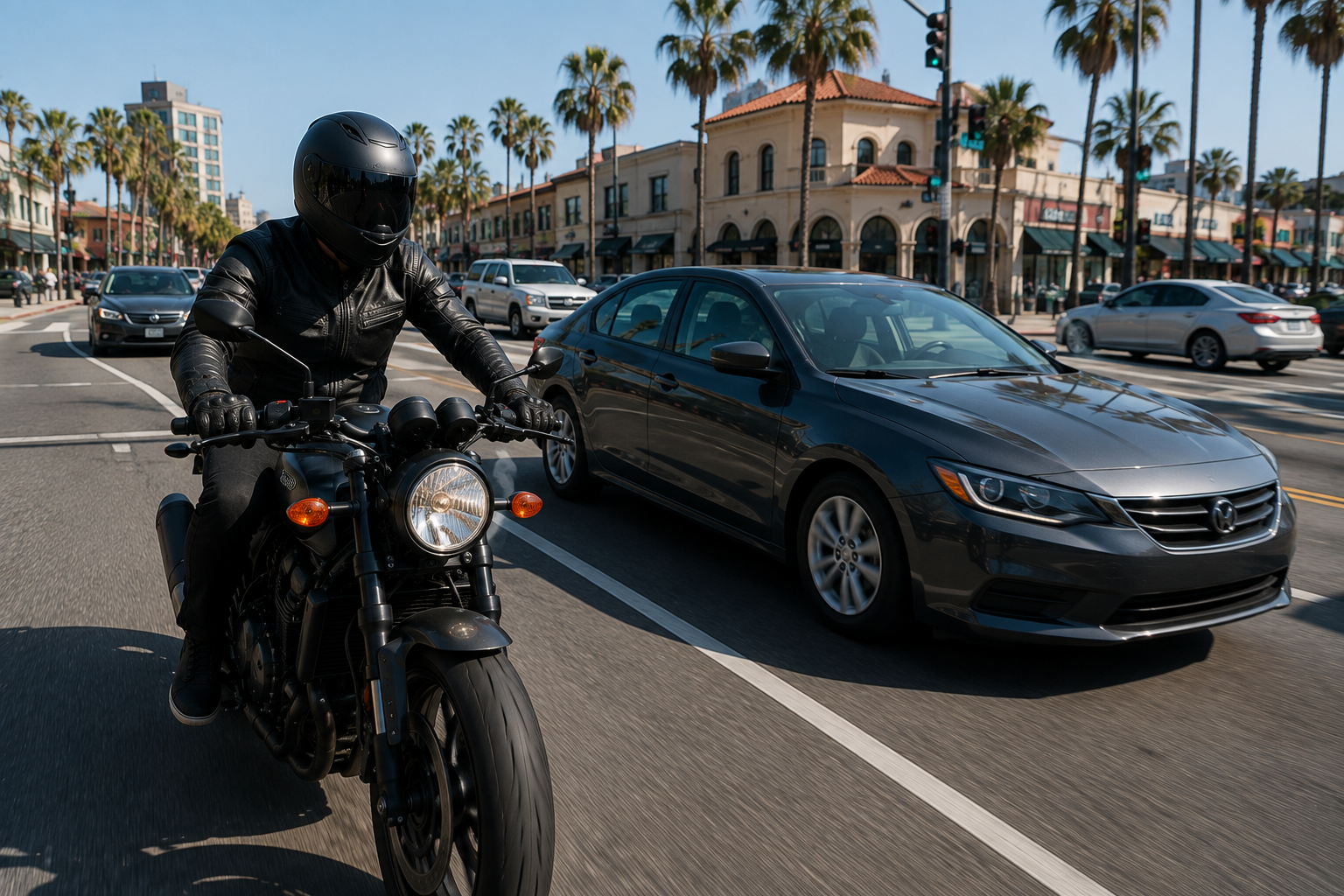
Lane changes are one example. A driver may move across lanes while attempting to reach a passenger pickup location or follow navigation directions. Motorcycles can be difficult for drivers to see, particularly when a motorcycle is traveling alongside or behind a vehicle. A sudden lane change can leave a rider with very little time to react.
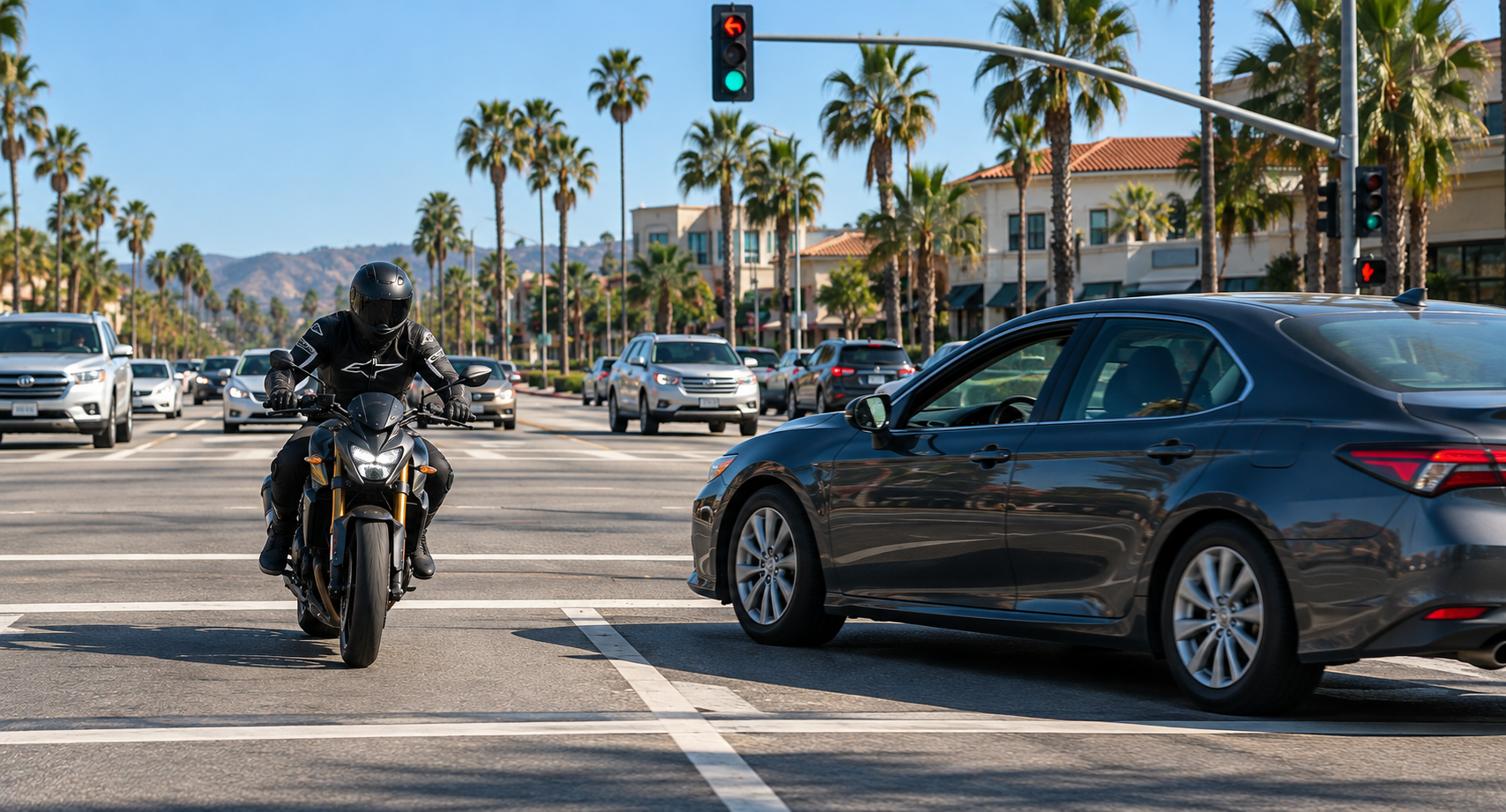
Left-turn collisions can also be serious. A rideshare driver making a turn may fail to recognize an approaching motorcycle, particularly at an intersection with multiple traffic lanes. A motorcycle traveling straight through the intersection may then collide with the turning vehicle.
Sudden stops are another potential hazard. Rideshare drivers may stop near a curb, driveway, hotel, restaurant, shopping center, or other pickup location. A motorcycle approaching from behind may have limited time to respond if the vehicle stops unexpectedly.
Distracted driving may also become an issue when a driver interacts with a rideshare application or navigation system. Whether a driver was distracted at the moment of a crash is a factual question that should be determined from available evidence rather than assumed.
4. Determining Who May Be Responsible
Liability in a motorcycle accident involving an Uber or Lyft vehicle depends on the facts of the collision. The rideshare driver’s actions may be examined to determine whether the driver failed to use reasonable care, violated a traffic rule, or otherwise contributed to the crash.
Other factors can also matter. Traffic signals, roadway design, weather, visibility, motorcycle positioning, vehicle speed, road conditions, and the actions of other drivers may all contribute to a collision. An investigation should consider the entire sequence of events rather than focusing only on the fact that one vehicle was being used for rideshare purposes.
California also follows comparative negligence principles. This means that more than one person may potentially share responsibility for an accident. If evidence establishes that multiple parties contributed to the injuries, the allocation of fault can affect the amount of damages that may ultimately be recovered.
This makes accurate evidence particularly important. A motorcyclist should not assume that an insurance company’s initial assessment of fault is necessarily the final determination. Statements from witnesses, photographs, traffic-camera footage, vehicle damage, and other evidence may provide a more complete picture of what occurred.
5. What Evidence Can Help Establish What Happened?
Evidence can become especially important when a rideshare driver and a motorcyclist provide different accounts of a collision. Information collected shortly after the accident may help establish vehicle positions, traffic conditions, injuries, and the sequence of events.
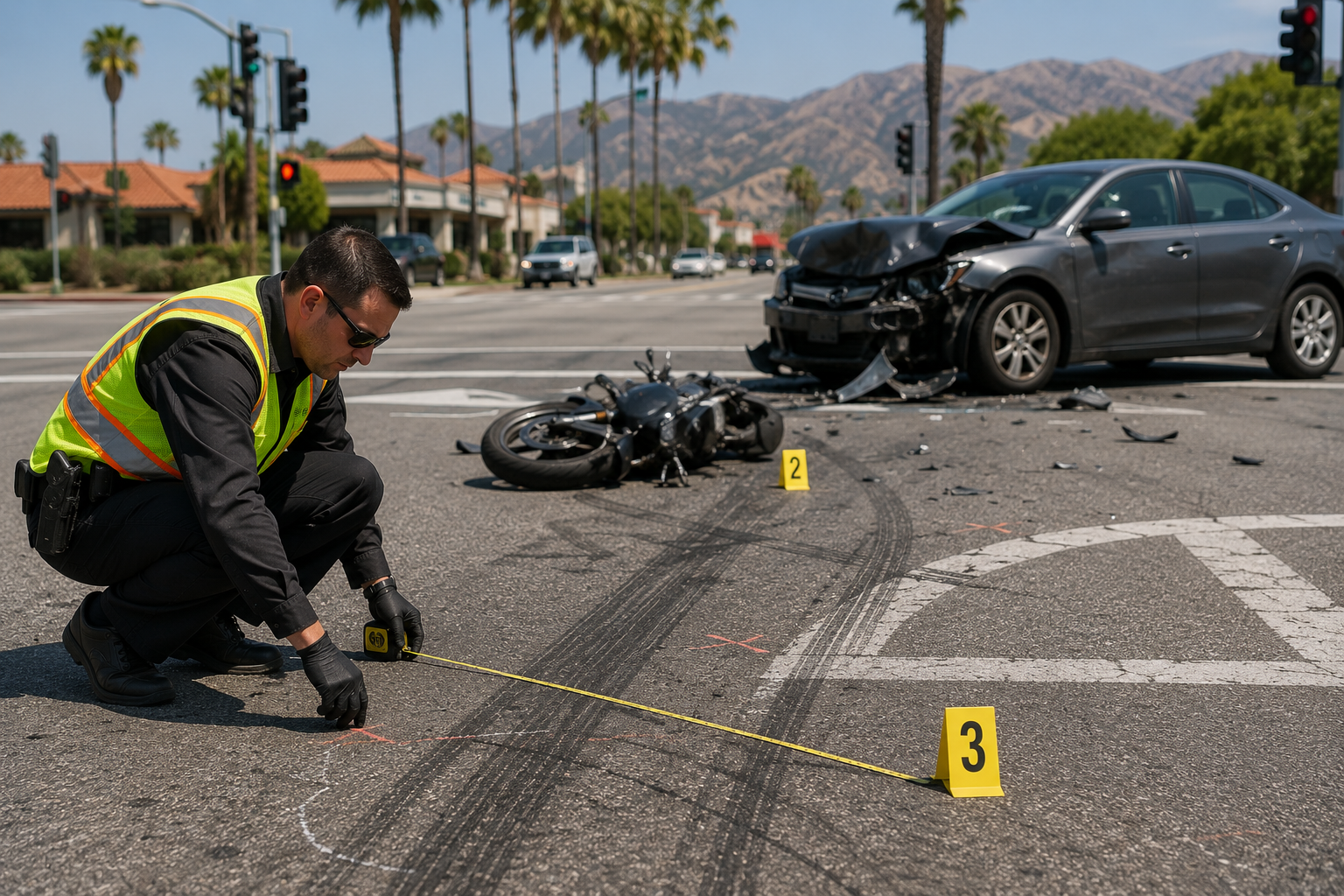
Photographs of the motorcycle, rideshare vehicle, surrounding roadway, traffic signals, lane markings, debris, skid marks, and nearby businesses can be useful. If the rider is physically able to do so, photographs should be taken from several angles rather than concentrating only on the damaged vehicles.
Witness information can also be valuable. People who saw the collision may be able to describe which vehicle had the right of way, whether a driver changed lanes, whether a turn was made suddenly, or what happened immediately before impact.
Other potential evidence can include police reports, medical records, repair estimates, surveillance video, traffic-camera footage when available, photographs taken by witnesses, and relevant insurance documents. In a rideshare collision, information establishing the driver’s status within the rideshare application may also become relevant to the insurance investigation.
Riders should preserve documents and photographs rather than deleting or altering them. Keeping original files can help maintain an accurate record of the evidence available after the crash.
6. Why the Driver’s Rideshare Status Matters
One of the most important questions in a rideshare motorcycle accident may be what the driver was doing at the time of the collision. A driver who was not using a rideshare application may have a different insurance situation from a driver who was actively working through the platform.
For example, a driver may have been traveling for personal reasons immediately before opening the application. Another driver may have been waiting for a ride request. A different driver may already have accepted a passenger request and been traveling toward the pickup location. Another may have been transporting a passenger when the collision occurred.
These distinctions are important because California’s TNC insurance requirements treat these periods differently. The CPUC’s current rideshare insurance guidance explains the applicable coverage structure and the different periods of TNC activity.
Consequently, information about the driver’s rideshare activity should be preserved when available. The driver may have relevant trip information within the rideshare application, while the rideshare company may maintain records associated with the trip. These records can become relevant when determining which insurance coverage applies.
7. Injuries Can Be Particularly Serious for Motorcyclists
Motorcyclists generally have less physical protection than people inside passenger vehicles. A rider can be thrown from the motorcycle, struck by another vehicle, or forced onto the pavement during a collision. As a result, injuries may involve the head, neck, spine, chest, arms, legs, or other parts of the body.
Common motorcycle accident injuries can include fractures, road rash, ligament injuries, traumatic brain injuries, spinal injuries, and soft-tissue injuries. The seriousness of an injury cannot always be determined immediately after a crash, particularly when adrenaline temporarily masks symptoms.
Anyone involved in a motorcycle collision should seek appropriate medical evaluation. Keeping medical records and following recommended treatment can also create a documented timeline of the injuries and recovery process.
The site’s existing article on the importance of seeking medical attention after a motorcycle accident provides additional information about why prompt medical evaluation can matter following a crash.
8. Insurance Companies May Investigate the Circumstances
After a motorcycle accident, more than one insurance company may potentially become involved. Depending on the circumstances, there may be questions concerning the motorcyclist’s coverage, the rideshare driver’s personal policy, and insurance associated with the transportation network company.
Insurance adjusters may request information about the accident, injuries, motorcycle damage, medical treatment, and circumstances surrounding the collision. Riders should provide truthful and accurate information but should also understand what documents they are being asked to provide and why.
It can also be important to distinguish between reporting an accident and agreeing with an insurer’s interpretation of liability. Reporting a collision does not necessarily mean accepting responsibility for causing it.
The site’s existing guide on dealing with insurance companies after a motorcycle accident discusses additional considerations when communicating with insurers after a crash.
9. Preserving Digital and Physical Evidence
 Modern rideshare accidents can involve more than traditional physical evidence. Digital information may become relevant because rideshare drivers use applications for accepting trips, navigating, and communicating with passengers. The availability and use of such information will depend on the circumstances and applicable rules.
Motorcyclists may also have useful digital evidence of their own. Helmet cameras, motorcycle cameras, smartphones, navigation devices, and nearby security cameras can sometimes provide information about what happened before or during a collision.
It is important not to assume that evidence will remain available indefinitely. Security-camera systems may overwrite recordings, witnesses may become difficult to locate, and physical evidence can change as vehicles are repaired or removed from the scene. Preserving available information as early as reasonably possible can therefore be important to an accident investigation.
10. How Riders Can Reduce Rideshare Collision Risks
Motorcyclists cannot control how other drivers behave, but defensive riding can help reduce exposure to common hazards. Riders should maintain awareness of vehicles around them, avoid remaining in blind spots, and anticipate that a vehicle may change lanes or stop unexpectedly.
Extra caution can be useful around hotels, restaurants, shopping centers, airports, entertainment venues, and other locations where rideshare pickups and drop-offs are common. A vehicle stopped near a curb may suddenly merge back into traffic, while a driver searching for a destination may make an unexpected maneuver.
Keeping an appropriate following distance also provides additional time to react when traffic changes. Riders should use proper protective equipment and remain particularly attentive at intersections, where turning vehicles can create serious collision risks.
For additional riding guidance, the site’s Motorcycle Safety resources provide information covering safer motorcycle practices and road awareness.
Conclusion
Motorcycle accidents involving Uber and Lyft vehicles can require a more detailed investigation than an ordinary traffic collision because the driver’s rideshare status may affect the insurance coverage involved. Determining whether the driver was waiting for a request, traveling to pick up a passenger, or transporting a passenger can be important when evaluating the available insurance coverage.
Evidence such as photographs, witness information, police reports, medical records, vehicle damage, surveillance footage, and relevant rideshare information can help establish what happened. Understanding the insurance structure and preserving important evidence can also help clarify the issues that may arise after a collision.
For Orange County motorcyclists, staying aware of rideshare vehicles and practicing defensive riding can help reduce risks on busy roads. When a collision does occur, documenting the circumstances carefully and understanding the insurance issues involved can be important parts of protecting a motorcycle accident claim.